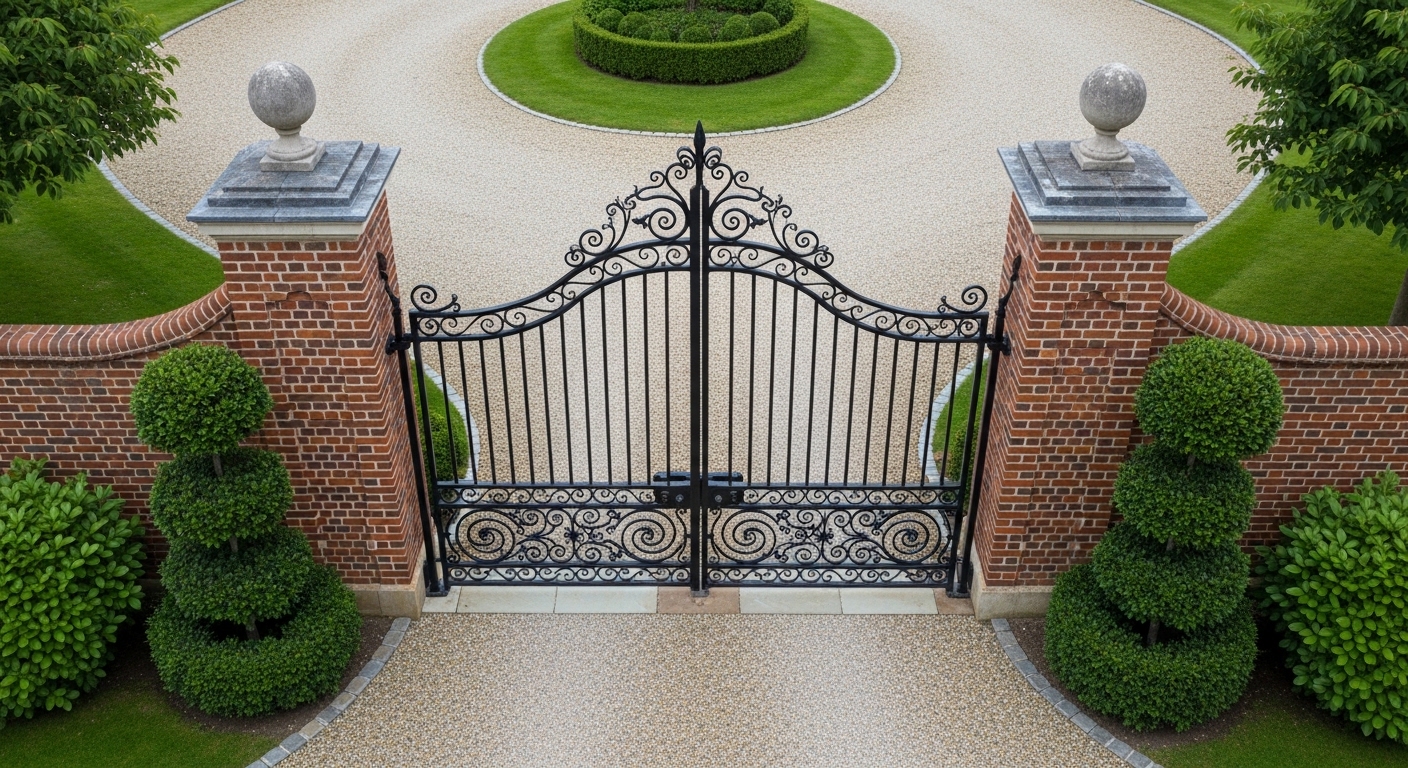
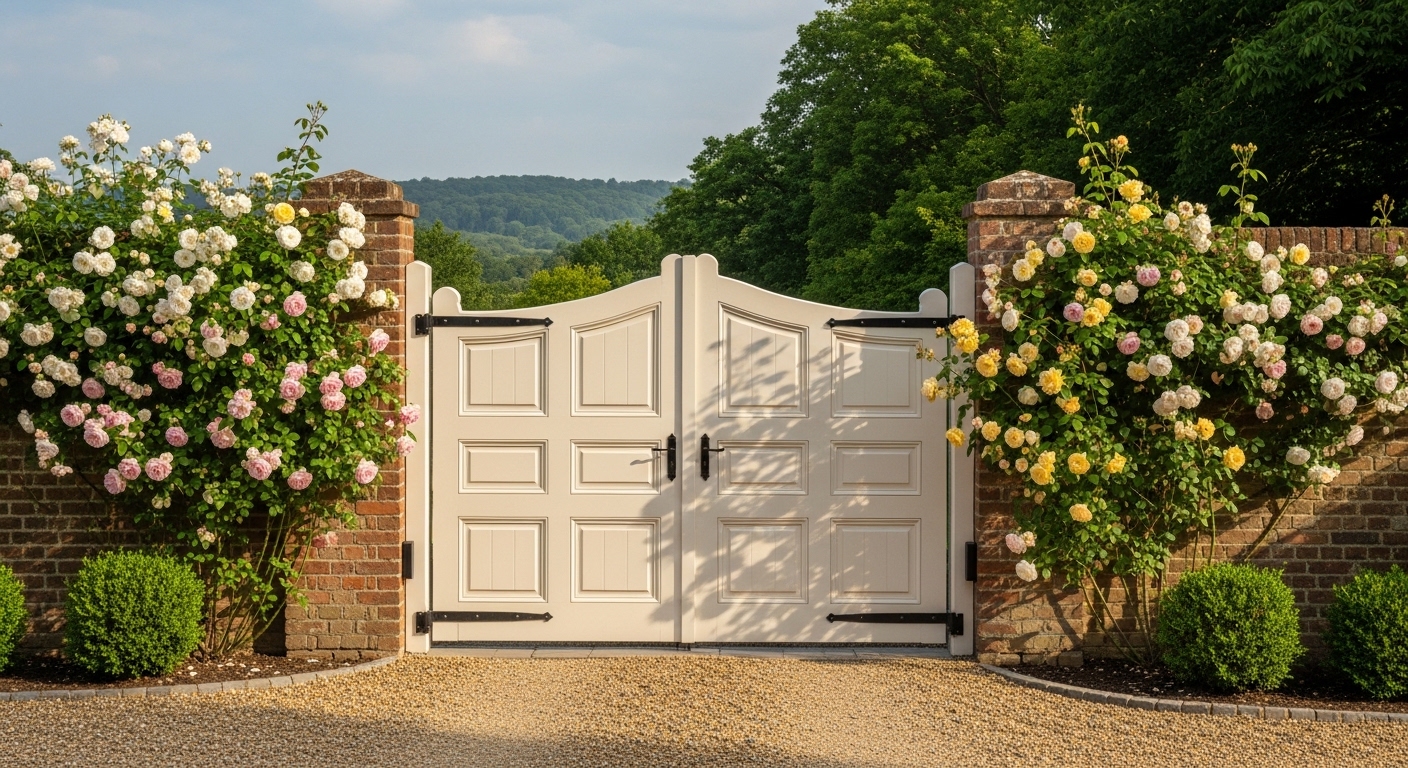
Wrought iron is the dominant gate material on the premium residential streets of North Surrey, and it has been for the better part of a century. Weybridge, Cobham, Esher, Walton-on-Thames, Leatherhead, and the surrounding belt of detached properties produce more wrought iron gate installations per square mile than almost anywhere else in England. The combination of substantial houses, gravel driveways, brick or stone pillars, and buyers with both the means and the expectation to specify properly makes this part of Surrey the natural home of the high-end gate market.
If you are considering wrought iron gates for your Surrey property, the investment is significant and the specification decisions matter for decades. This guide covers everything from what distinguishes genuine wrought iron from fabricated mild steel, through to surface treatment, motor selection, planning requirements, and how to assess a fabricator before placing an order.
What Wrought Iron Actually Is, and How It Differs From Mild Steel
The term wrought iron is widely misused in the gate industry. Most gates marketed as wrought iron in the UK are fabricated from mild steel, shaped using metalworking tools rather than forge and hammer. Genuine wrought iron is a low-carbon iron alloy worked while hot, with distinctive grain characteristics and a texture that accepts surface treatment differently to rolled steel. Both are used in gate fabrication, and the distinction matters to some buyers and not to others, but you should know what you are buying.
For most Surrey homeowners, the practical question is not the metallurgy but the fabrication quality. A gate made from mild steel by a skilled blacksmith using traditional methods, with hand-forged decorative elements, scrollwork, and spear finials, will outperform a gate assembled from pre-formed steel sections regardless of what material label either carries. The fabricator's workshop, their method, and their project history matter far more than the label on the specification sheet.
Free Matching Service
Ready to get driveway gate quotes?
Get matched with vetted Surrey installers, no obligation and no cost.
Design Options for Surrey Properties

Wrought iron gates for Surrey residential properties fall broadly into three design traditions. The estate gate is the grandest: arched top rails, heavy decorative scrollwork, gilded or painted finials, and a scale proportionate to wide gravel entrances between stone or dressed brick pillars. This is the style associated with the larger detached properties in the Cobham, Esher, and Weybridge market.
The more restrained town gate suits period properties in the conservation areas of Guildford, Godalming, Farnham, and Reigate: straight or gently curved top rails, vertical bar construction with modest decorative elements at the mid-rail and finial points, proportioned for a standard residential opening of three to four metres. The contemporary gate uses the same material with a flat-bar or geometric design language: no scrollwork, clean lines, and a finish that suits modern extensions or new build properties in the Surrey commuter belt.
Surface Treatment: The Decision That Determines Longevity
The surface treatment applied to a wrought iron gate is the most important specification decision after the design itself. The correct process for any outdoor steel gate in Surrey is hot-dip galvanising followed by primer and topcoat. The gate is immersed in a bath of molten zinc after fabrication, forming a metallurgical bond between the zinc and every surface of the steel, including internal faces of hollow sections, weld points, and any area that cannot be reached by a brush or spray. When the decorative topcoat is eventually damaged, the zinc layer continues to protect through a sacrificial mechanism, corroding itself rather than allowing the substrate to rust.
Cold galvanising, zinc-rich primer applied by brush, is a substantially inferior specification that is sometimes offered to reduce cost. It provides surface-level corrosion resistance with no bond to the steel and no protection at cut edges or welds. For a gate that costs several thousand pounds and is expected to last decades, hot-dip galvanising is not optional. Any fabricator offering cold galvanising as an equivalent is not meeting the standard the Surrey market expects.
Motor Selection for Wrought Iron Gates
Wrought iron gates are heavier than aluminium or steel fabrications of equivalent size. Motor specification must account for the actual gate weight, not an estimated figure. A gate that is undersized for the motor will work reliably for six to eighteen months before wear accelerates, torque limits trip repeatedly, and the system begins to fail in ways that are expensive to diagnose and repair.
Underground motors are the standard specification on premium Surrey installations. The motor sits in a chamber below the post, invisible when the gate is closed, and the mechanism connects to the gate via a rotary arm below ground level. The result is a gate that operates with no visible mechanism on either face, which is the correct aesthetic for a gate of this character. Ram-arm motors, mounted on the face of the gate or post, are technically equivalent in terms of function but are more commonly specified on retrofit projects where the post foundations do not permit excavation.
- FAAC, BFT, and CAME underground motors are the most commonly specified brands in the Surrey premium market
- Motor torque rating should be matched to the gate weight, not to a standard residential specification
- Battery backup is a standard inclusion on quality installations, maintaining operation through power cuts
- Video intercom and proximity access systems integrate directly with the motor control board
- Smart home integration via GSM module or dedicated app is available from all leading motor manufacturers
Planning Considerations for Surrey Wrought Iron Gates
Most residential wrought iron gate installations in Surrey do not require planning permission. Permitted development rights cover gates up to two metres in height that open onto the property. The height limit reduces to one metre for gates fronting a classified road. Where a property is listed, in a conservation area, within the Surrey Hills AONB, or subject to an Article 4 direction, additional consent or prior notification may be required.
Surrey has an unusually dense concentration of these designations. The Surrey Hills AONB covers a substantial part of the county, Green Belt applies to most of the remaining rural land, and conservation areas exist throughout every district. In practice, the planning position needs to be confirmed for any property that might be affected before fabrication begins. An installer working regularly in the Surrey market will know how to check and will advise you at the site survey stage.
What a Wrought Iron Gate Installation Costs in Surrey in 2026
A standard pair of wrought iron swing gates with underground motors, video intercom, and full safety commissioning for a Surrey residential driveway starts from around £7,000 to £8,000 for a competent fabrication in a restrained design. Estate-grade installations with extensive scrollwork, gilded finials, large pier lanterns, and advanced access management reach £15,000 to £20,000 and above for the most ambitious projects in the Cobham and Weybridge market.
The fabrication lead time for a bespoke wrought iron gate is typically four to eight weeks from confirmed order, depending on the fabricator's current workload and the complexity of the design. Allow the full programme when planning your project, and confirm the installation date at the point of placing your order rather than assuming it can be arranged at short notice.