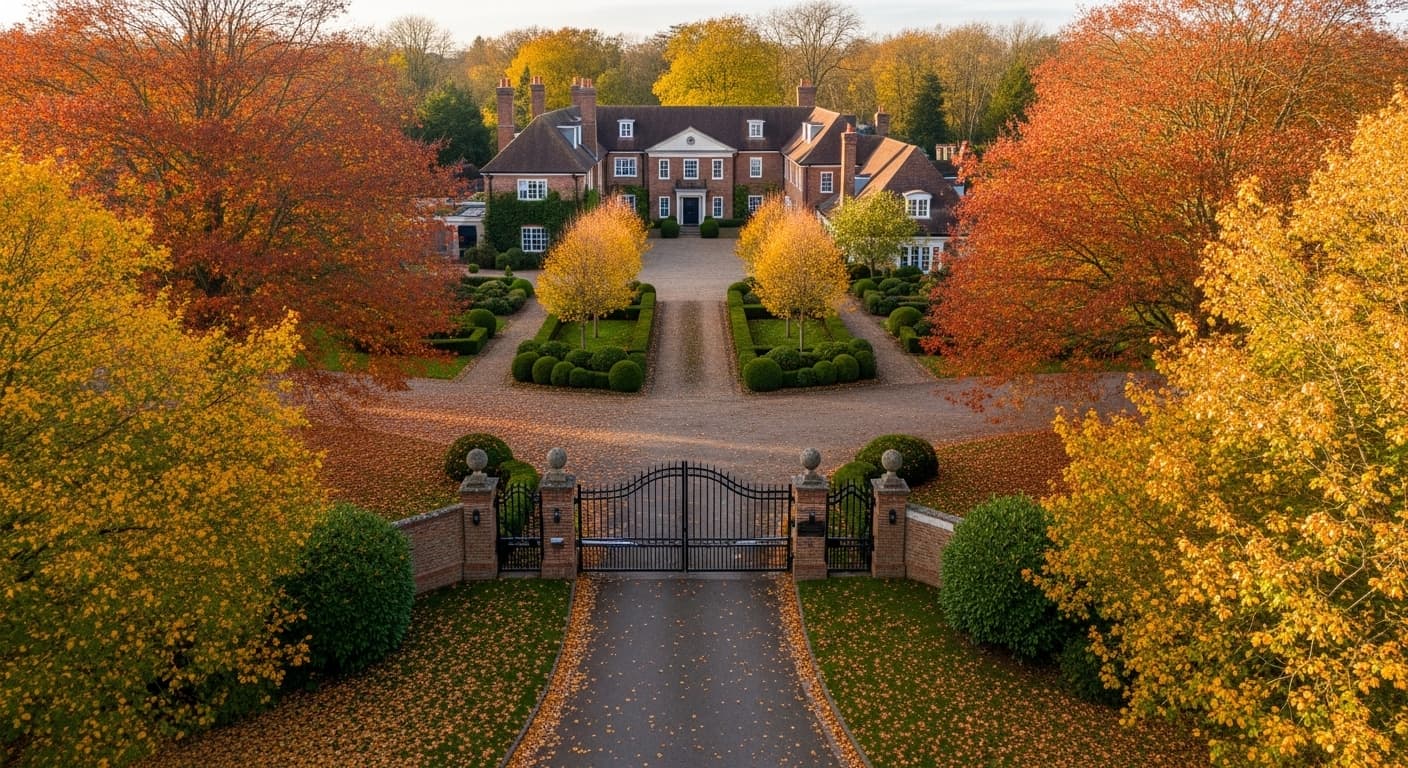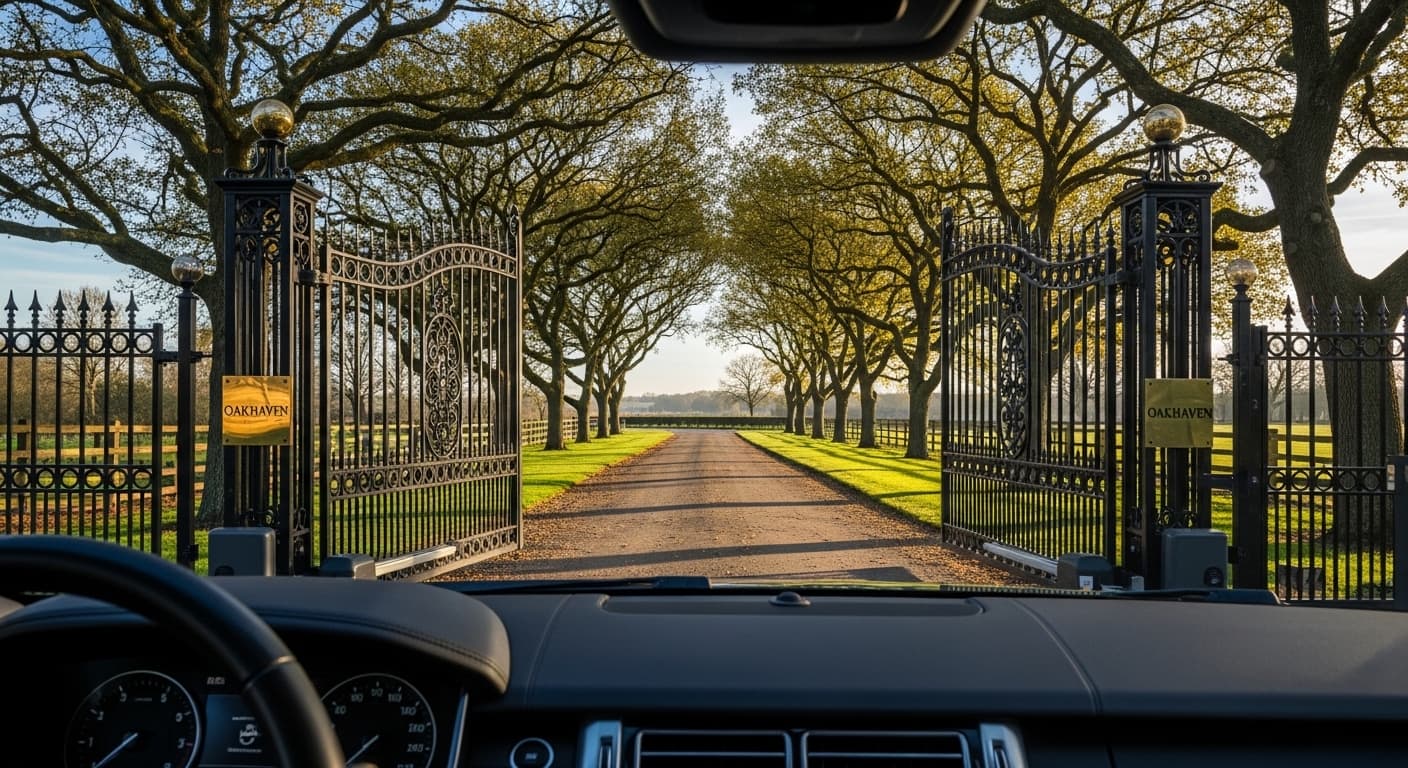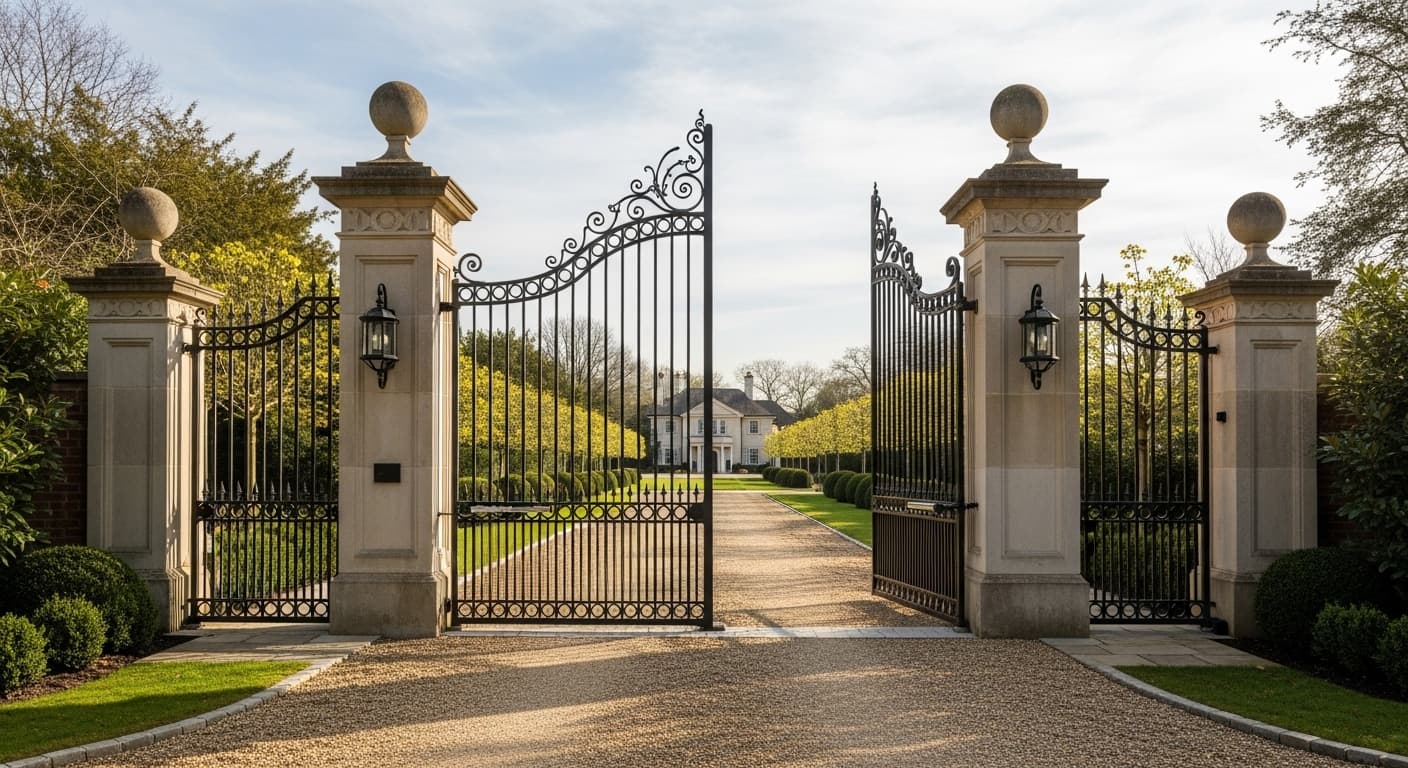
On the larger Surrey estates the gates are rarely the first piece of security to arrive. A property in Wentworth, Oxshott, or the Crown Estate at Oxshott has usually had cameras on the outbuildings and an intruder alarm on the house for years before the owner decides to gate the entrance. That order of events shapes the whole job. The question at the survey is almost never whether to have CCTV and an alarm, but whether the new entrance will talk to the ones already in place or sit beside them as a separate island of kit with its own app, its own cabling, and its own set of things to go wrong.
Getting that integration right is the difference between a gate that feels like part of the house and one that feels bolted on. When the entrance is joined up properly, a camera at the gate records to the same drive as the cameras on the house, an event at the gate can arm or trigger the wider system, and the whole lot is viewed through one screen rather than three. When it is not, the household ends up managing a gate that knows nothing about the alarm and an alarm that knows nothing about the gate. This is how the two are joined, and where the coordination usually falls down.
What Actually Connects a Gate to a Wider System
The physical link between an automated gate and an existing security system is usually simpler than owners expect, because it comes down to a handful of low-voltage signals rather than any clever shared intelligence. A gate control board has spare terminals that can close a contact when the gate is triggered, when it reaches fully open, or when a fault occurs. An alarm panel and a CCTV recorder each have input terminals that can receive exactly that kind of contact and act on it. Wire one to the other through what installers call a trigger relay and the gate can now tell the rest of the system what it is doing, and in some setups be told what to do in return.
In practice this makes several genuinely useful things possible. A camera positioned to read the entrance can be set to record on the gate-opening event, so every arrival produces a clip rather than the recorder running blind. The gate can be linked to the alarm so that closing and locking the entrance at night part-sets the perimeter, or so that a forced-open gate raises an alarm condition rather than passing unnoticed. Where the existing recorder supports it, the gate camera simply becomes another channel on the same system, viewed and searched alongside the house cameras rather than through a separate feed. None of this requires ripping out what is already there; it requires the new gate to be specified to hand over the right signals.
Ready for driveway gate quotes?
Three Surrey installers.
Free site surveys, detailed written quotes, no obligation. We match you with up to three specialists who cover your Surrey postcode.
Shared Cabling and the Trench You Only Dig Once
The moment that decides how cleanly the systems join is the groundwork, and on an estate that means the trench from the house to the entrance. A long Surrey drive needs armoured cable run to the gates for power and control regardless, and that trench is the single best opportunity to also carry the data cable that will let a gate camera record back to the house recorder rather than to a separate box at the pillar. Pulling that cable in while the trench is open costs very little; retrofitting it later means digging the drive up twice. This is why the security integration should be on the table at the gate automation design stage and not treated as a later add-on, because the cheapest time to future-proof the link is before the ground is closed.
Cabling choices also decide how resilient the joined-up system is. A hardwired data run from the gate camera to the house recorder is not dependent on the property wifi reaching the far end of a long drive, which it often will not, and it keeps recording even if the broadband drops. Wireless links between the entrance and the house exist and can work, but on the long, tree-lined drives common across the North Downs they are the part most likely to be unreliable, so a serious installation runs cable where it can and treats wireless as the fallback. These groundwork decisions are a real part of what an estate-grade entrance costs, and they sit inside the wider picture of what driveway gates cost in Surrey rather than being an optional line to trim.
Why the Installer Coordination Is the Hard Part
The technical connection is straightforward; the coordination between trades is what quietly goes wrong. A driveway gate specialist knows gates and motors, an alarm and CCTV firm knows the house security, and on many jobs the two never speak to each other. The gate goes in with its own separate camera and app, the security firm is never asked to integrate it, and the owner is left with two systems that happen to share a driveway. Avoiding that outcome is largely a matter of asking the right question before work starts and choosing a gate installer who is comfortable interfacing with a third-party alarm and CCTV company rather than one who quietly installs a parallel system to keep their own life simple.
It is worth checking who holds the accreditation on the security side, because integration touches a regulated part of the setup. An intruder alarm connected to a monitoring service or to police response is installed and maintained to recognised standards, and the firm that maintains it should sign off any change that touches the alarm panel, including a new gate input. The recognised route is to use a certified security installer, which in the UK usually means a company approved under the electronic security schemes run by the National Security Inspectorate, and to have the gate installer coordinate with them rather than around them. When you are choosing the gate company, this willingness to work alongside your existing security provider is one of the practical things to weigh, and it belongs in the same assessment as everything else covered when choosing a gate installer in Surrey.
The Data Protection Line an Entrance Camera Crosses
Any camera at the gate that can see beyond your own boundary brings a responsibility that a camera pointed at your own courtyard does not. To be useful an entrance camera almost always captures part of the lane or road outside the gates, and at that point the household is treated as a data controller for the footage. This is manageable and rarely a reason to hold back, but it needs to be handled deliberately: the camera framed as tightly to your own approach as the view allows, a sensible retention period set on the recordings rather than keeping everything forever, and a clear reason the camera is there. The Information Commissioner sets this out plainly in the ICO guidance on home CCTV systems, and a security firm worth using will treat it as part of the commissioning rather than an afterthought.
On the high-hedge lanes of the Surrey Hills and the North Downs villages, framing an entrance camera to capture the drive without sweeping a neighbour's frontage takes some thought, which is another reason the gate and the security work should be planned together. Get the placement right at the design stage and the joined-up system does exactly what an estate owner wants: a dated record of every vehicle and visitor at the entrance, held on the same system as the rest of the property, viewed from one screen.
What to Ask Before the Gate Goes In
- Confirm whether the gate control board can output the trigger, open, and fault signals your alarm and CCTV recorder can accept
- Pull a hardwired data cable to the entrance while the power trench is open, even if you integrate the camera later
- Ask the gate installer to coordinate directly with your existing alarm and CCTV firm, not to fit a parallel system
- Have any change to the alarm panel signed off by the certified firm that maintains it
- Frame the entrance camera to your own approach and set a sensible retention period on the recordings
- Decide up front whether the gate should part-set the alarm at night or simply record on every arrival
A gated entrance that records to the house system, arms with the alarm, and shows on one screen is a materially more secure and more usable property than one where the gate and the security sit in separate silos, and the cost difference between the two is mostly planning rather than kit. On an estate that already carries real cameras and a real alarm, the aim is to add the gate to what exists, and that is decided at the survey rather than discovered afterwards. Where the entrance is a fully welded metal gate, the same metal driveway gate installation can be specified with the cable routes and control terminals the integration needs designed in from the start.