BS EN 12453 is the British and European standard for safety in use of power operated pedestrian doorsets and gates. It defines the safety requirements that any automated gate system must meet before it can be handed over to a residential or commercial customer in the UK. Despite being a mandatory requirement rather than a best practice recommendation, a significant number of gate installations across Surrey and the wider UK are commissioned without proper compliance with this standard.
The consequences of non-compliant installation are serious. An automated gate that has not been correctly commissioned for force limits, safety edges, and photocell response is a crush risk. Incidents involving automated gates, including fatalities, have been recorded in the UK and have consistently involved either absent safety systems or systems that were installed but not correctly calibrated. Understanding what BS EN 12453 requires allows you to verify compliance at handover and to insist on correct standards from any installer you engage.
What BS EN 12453 Requires
The standard requires that any automated gate system meets defined maximum impact force limits at the leading edge of the gate (the edge that closes against the strike post or the other gate leaf). The permitted impact force varies depending on whether the gate is capable of trapping (a gate that can pin a person against a fixed structure) or non-trapping. For most residential swing and sliding gates, which can trap, the impact force must not exceed 400 Newtons as a dynamic force and 150 Newtons as a static force. These limits must be measured and documented at commissioning.
The standard also requires: a safety edge (also called a sensing edge) on the leading face of each gate leaf, which stops and reverses the gate on contact with an obstruction; photocell beams across the full width of the gate opening, positioned to detect a person standing in the path of the closing gate; an auto-reverse function that responds to increased motor torque caused by an obstruction in the gate arc; and a manual release that allows the gate to be operated by hand in the event of a power failure.
Free Matching Service
Ready to get driveway gate quotes?
Get matched with vetted Surrey installers, no obligation and no cost.
Safety Edges and Photocells: The Two Critical Systems
Safety edges are rubber or PVC strips mounted on the leading face of the gate, containing a pressure-sensitive element that triggers a stop-and-reverse command when it contacts an obstruction with sufficient force. They must be mounted on the full height of the leading edge. A safety edge mounted only on the lower half of the gate, or mounted on the inside face rather than the leading edge, does not meet the standard.
Photocell beams are infrared sensors installed in pairs across the gate opening. The transmitter sends a beam to the receiver; if the beam is interrupted while the gate is closing, the gate stops and reverses. Photocells must be positioned at a height that detects a child as well as an adult. A single photocell beam at waist height only does not satisfy the standard, which requires the opening to be protected at low level as well.
Force Limit Testing: What Happens at Commissioning
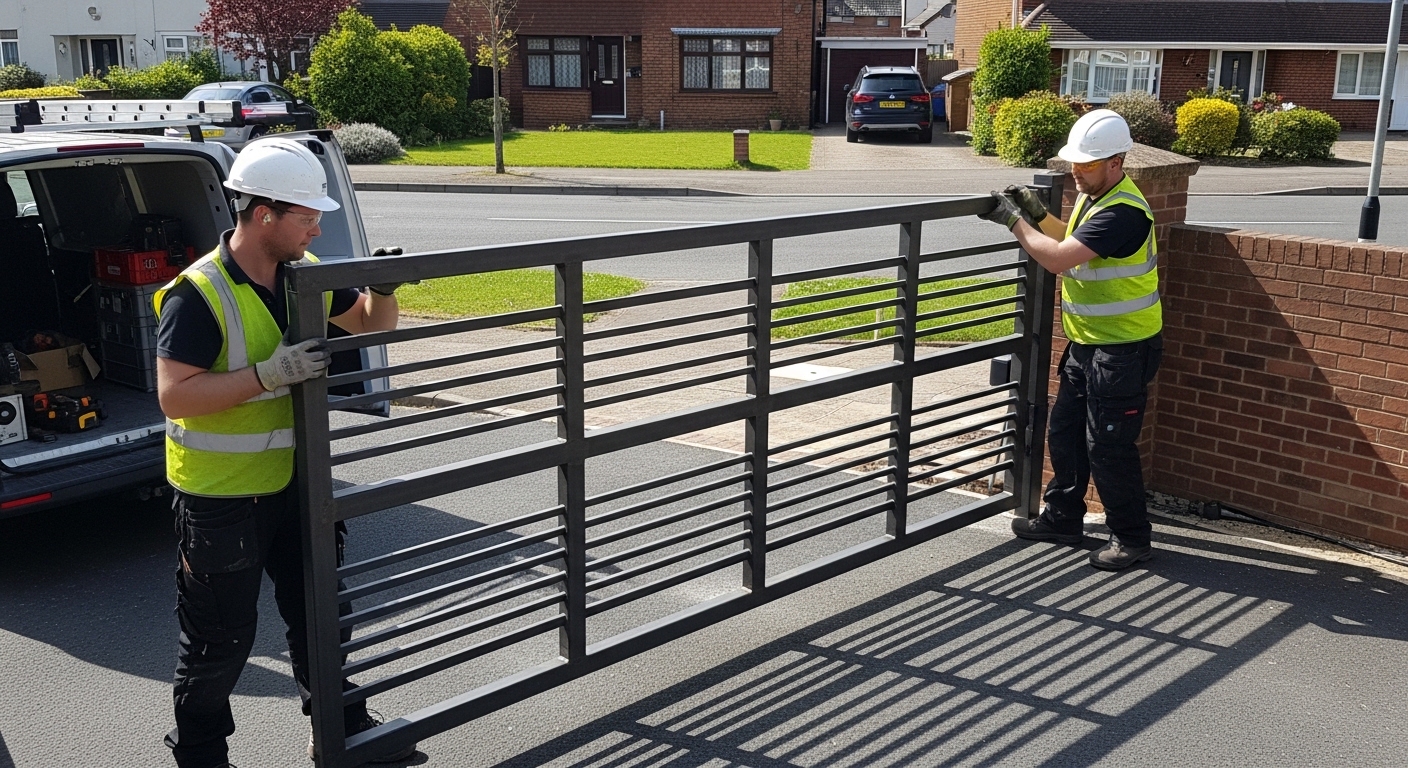
A properly commissioned automated gate installation involves physical testing of the impact force at the leading edge using a calibrated force measurement device. The installer runs the gate against a test instrument, records the dynamic and static force readings, and adjusts the motor torque settings and safety edge sensitivity until the readings are within the permitted limits. This process cannot be done by eye. It requires the measurement equipment and a process that is documented in the commissioning record.
Ask any installer before engaging them whether they carry a force measurement device and whether they will provide a written commissioning record at handover. An installer who cannot answer yes to both of these questions is not in a position to commission a gate to BS EN 12453 and should not be considered for a gate automation project regardless of their price.
The Commissioning Record and Declaration of Conformity
At handover, a BS EN 12453 compliant installation should be accompanied by a written commissioning record that documents the force measurements taken, the photocell and safety edge tests completed, the travel limit settings applied, and the manual release test. Some installers also provide a Declaration of Conformity, which is a formal document stating that the installation meets the applicable standards. This document is relevant to your home insurance and, in the event of an incident, it is primary evidence that the system was correctly installed.
Keep the commissioning documentation with your property records. If you sell the property, the documentation should be passed to the buyer. If the gate system is serviced or modified in the future, a new commissioning record should be issued after any work that affects the safety systems.
Annual Servicing and Ongoing Compliance
BS EN 12453 compliance is not a one-time certification at installation. An automated gate system should be serviced and re-tested annually. Safety edges wear, photocell alignment shifts, travel limit settings drift, and motor torque increases as mechanical components wear. An annual service by a competent engineer should include re-testing of force limits and safety sensor response, not just mechanical lubrication and inspection. Ask your service engineer explicitly whether force testing is included in the annual service they offer.
What to Do if Your Existing Gate Was Not Commissioned to Standard
If you have an automated gate that was installed without proper safety commissioning, the most straightforward remedy is to arrange a safety assessment and commissioning service from a competent engineer. This is distinct from a standard service and involves the full force measurement and photocell testing process. The cost is typically £150 to £250 and the result is a commissioned, documented gate system that meets the current standard. Installers covering Surrey who specialise in gate automation can carry out this work on any make or model of gate system.